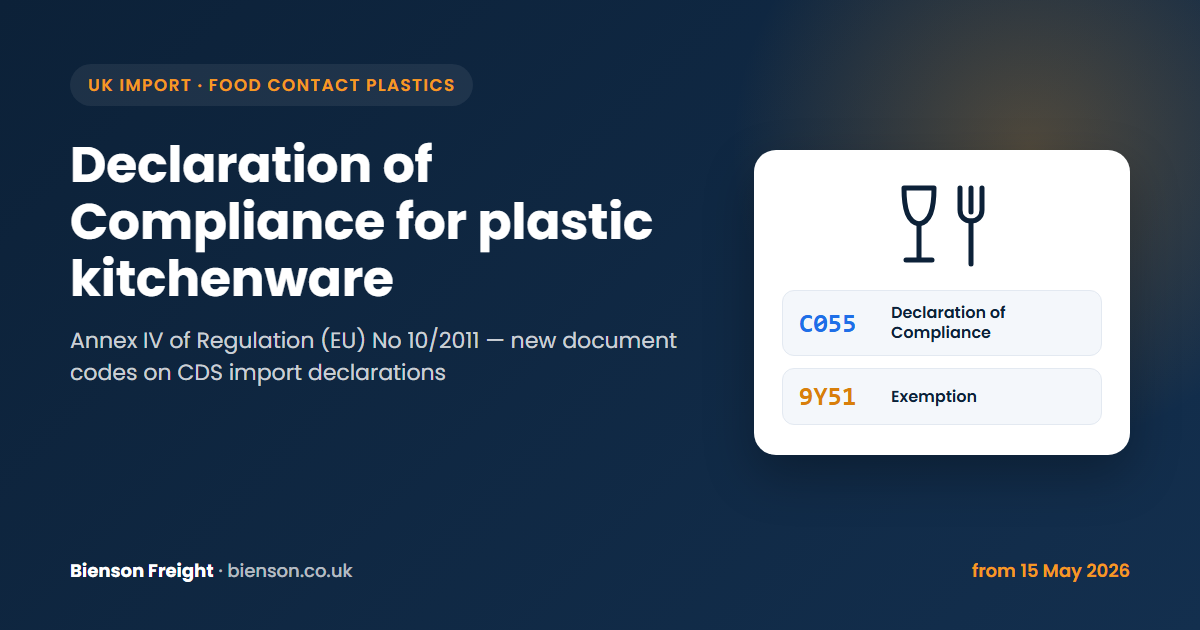
Since 15 May 2026, every import declaration into Great Britain for plastic tableware and kitchenware classified under commodity code 3924 10 00 90 must carry one of two document codes: C055, for a Declaration of Compliance (DoC) under Article 15 of Commission Regulation (EU) No 10/2011 containing the information listed in its Annex IV, or 9Y51, a new UK exemption code. Without either code, the measure’s condition is not met and the tariff action is ‘Import/export not allowed after control’. The measure covers goods from all countries, including Poland and the rest of the EU, although the EU tariff has no equivalent.
In practice, C055 is needed only for polycarbonate baby bottles (tariff footnote CD801). Everything else under this commodity code – plastic plates, cups, cutlery, kitchen utensils and similar articles – is declared with 9Y51. Kitchenware containing polyamide or melamine has its own codes (see below).
What is the Declaration of Compliance?
Commission Regulation (EU) No 10/2011 of 14 January 2011 on plastic materials and articles intended to come into contact with food applies in Great Britain as assimilated law – EU law kept on the UK statute book after Brexit. The GB version, published on legislation.gov.uk, now differs in places from the EU text. The Regulation is sometimes wrongly cited as ‘10/2012’.
This article covers Great Britain. Northern Ireland follows EU food contact rules under the Windsor Framework, including the EU ban on bisphenol A (Regulation (EU) 2024/3190), which does not apply in GB. The C055/9Y51 measure appears only in the UK (GB) tariff, not in the Northern Ireland (XI) tariff, and we have not been able to confirm how it applies to imports into Northern Ireland.
Under Article 15, a written DoC must be available at every marketing stage other than retail for plastic food contact materials and articles, intermediate products and the substances used to make them. It is issued by the business operator, contains the information in Annex IV and must make the goods easy to identify. It must be renewed after substantial changes in composition or production that alter migration (the transfer of substances from the plastic into food), or when new scientific data becomes available. Under Article 16, the business operator must make supporting documentation – test results, calculations and other evidence of safety – available to the competent authorities on request.
What must the DoC contain?
The GB version of Annex IV lists nine items:
- identity and address of the business operator issuing the declaration;
- identity and address of the business operator that manufactures or imports the plastic materials or articles;
- identity of the materials or articles covered;
- date of the declaration;
- confirmation that the goods meet Regulation 10/2011 and Articles 3, 11(5), 15 and 17 of Regulation (EC) No 1935/2004;
- adequate information on substances (or their degradation products) whose restrictions or specifications are set out in the substance’s GB authorisation or in Annex II, so that downstream businesses can ensure compliance;
- adequate information on substances also restricted in food (migration data and, where appropriate, purity criteria);
- specifications on use: type(s) of food, time and temperature of treatment and storage, and the highest surface-area-to-volume ratio for which compliance was verified (or equivalent information);
- where a functional barrier (a layer that limits the migration of substances from the layers behind it) is used in a multi-layer material, confirmation of compliance with Article 13(2)–(4) or 14(2)–(3).
Item 6 reflects the GB text since 1 April 2025, when Annex I (the list of authorised substances) was removed from the GB Regulation; GB authorisations now sit in a register kept by the Food Standards Agency (FSA) and Food Standards Scotland (FSS). Following Regulation (EU) 2025/351, the EU version has 11 items; those changes apply in the EU and Northern Ireland, but not in Great Britain.
Who is responsible?
- Every business operator in the supply chain, except at the retail stage, must have a DoC available. It is typically issued by the manufacturer or the importer; Annex IV lists the issuer and the manufacturer or importer separately.
- When
C055is declared (with any status code other thanXB), the DoC and supporting documents must be held and produced to customs on request. In practice the importer must have them, whether or not it is established in the UK, and under indirect representation the agent, as declarant, must also be able to obtain them. - Separately, whatever code is declared, in England port health authorities, food authorities and the FSA can require the supporting documentation as competent authorities (Article 16).
9Y51is a legal declaration that the consignment does not need a DoC on import; sufficient evidence must be held and produced on request.- The customs agent declares the code and the DoC reference (or the
9Y51statement) in the Customs Declaration Service (CDS), based on the importer’s written instructions and documents. How far the agent shares responsibility depends on the type of representation (next point). - Under direct representation (the agent acts in the importer’s name), the importer is generally solely liable for the declaration’s accuracy; under indirect representation (the agent acts in its own name on the importer’s behalf – the only option for importers not established in the UK), the agent shares that responsibility.
C055 or 9Y51: which code applies?
How did this come about? Until 5 May 2026, polycarbonate infant feeding bottles had their own commodity code (3924 10 00 20), which already required C055. On 6 May 2026 the UK merged that code into 3924 10 00 90 to stay aligned with the EU code structure. From 8 to 14 May an interim measure required C055 for everything under 3924 10 00 90, with no exemption. From 15 May HMRC added the 9Y51 exemption for all other goods (HMRC Tariff stop press notice of 14 May 2026).
Polycarbonate baby bottles are singled out because of bisphenol A (BPA), the monomer used to make polycarbonate. Since 2011 BPA may not be used to manufacture polycarbonate infant feeding bottles (and since 2018 polycarbonate spill-proof drinking cups or bottles for infants and young children). In GB this restriction has sat since 1 April 2025 in the FSA/FSS register of authorised substances, where BPA is FCM substance No 151.
C055– polycarbonate baby bottles only. GB law prohibits using BPA to make polycarbonate infant feeding bottles, and tariff footnote CD619 states that importing such bottles made with BPA is prohibited. DeclaringC055does not make a BPA-based bottle lawful. We have found no official source confirming that BPA-free polycarbonate baby bottles are available, so talk to your supplier and to us before shipping.9Y51– all other goods under 3924 10 00 90, such as plastic plates, cups, cutlery and kitchen utensils.- Other commodity codes: kitchenware containing polyamide or melamine (3924 10 00 11 or 3924 10 00 19 – see below) and plastic drinks and water bottles, which HMRC advance tariff rulings (ATaRs – binding classification decisions for a specific product) place under 3924 90 00 90, outside this measure. A ruling is binding only for the product it covers, so confirm your own classification.
- Baby bottles of other plastics (e.g. PP or PPSU) are outside the
C055requirement. They are presumably classified under 3924 10 00 90 and declared with9Y51, but no HMRC ruling confirms this, so check the classification with us.
Important: in our reading (HMRC does not say this expressly), 9Y51 removes only the need to produce a DoC at import. It does not override Article 15: a DoC must still be available in business-to-business trade, and the goods must still comply with GB food contact law – including the restriction on polycarbonate spill-proof drinking cups or bottles for infants and young children, which footnote CD801 does not mention. Treat 9Y51 as a customs exemption, not a food law exemption.
Where to get the DoC
Ask the manufacturer or supplier for the DoC before shipping, and check that:
- every applicable Annex IV item is present (for example, item 9 applies only where a functional barrier is used);
- the product description matches the invoice;
- the declaration is dated and current;
- the conditions of use (food type, time, temperature) match how the product will actually be used.
DoCs from EU suppliers usually cite the current EU text of Regulation 10/2011, and there is no official GB guidance on whether an EU-format DoC is accepted as it stands. As the GB and EU lists of authorised substances have started to diverge, ask the supplier to confirm compliance with the GB rules too.
If the supplier cannot provide a DoC, the importer, as the business operator placing the goods on the GB market, can issue its own, backed by adequate supporting documentation: composition information from the manufacturer showing that only authorised substances were used, plus migration testing, ideally by a laboratory accredited to ISO/IEC 17025 (in the UK, the United Kingdom Accreditation Service, UKAS, accredits testing laboratories). Test results alone are Article 16 supporting documentation, not a DoC, and testing cannot bring a product made with unauthorised substances into compliance.
Watch for these red flags:
- ‘Natural’ plastics with bamboo fibre or other plant fillers (rice husk, wheat straw, hemp): the FSA and FSS say they should not be sold in GB, because the fillers are not authorised and, according to the Committee on Toxicity, can cause formaldehyde and melamine to leak into food above the legal limit;
- melamine and polyamide (nylon) kitchenware, especially from China and Hong Kong – a long-standing focus of UK enforcement.
How to declare C055 and 9Y51 in CDS
Document codes go in Data Element (DE) 2/3 (documents produced, certificates and authorisations, additional references) at item level. Union codes, which begin with a letter (e.g. C055), are declared before UK national codes such as 9Y51, although a single item normally carries either C055 or 9Y51, not both. According to HMRC guidance, a declaration fails validation if a required document code is missing.
C055: enter the reference number of the DoC and a document status code, for exampleAE(document attached, exhausted by this entry),AP(document attached, part use),GE(document with the goods, exhausted by this entry) orLE(document lodged previously, exhausted by this entry) – we will agree the right one with you. For every status code other thanXB, the DoC and supporting documents must be held and produced to customs on request. If the goods are below de minimis, status codeXBis used with the text ‘Below de minimis’ in the document reason field, but we have found no published HMRC de minimis quantity forC055, so do not useXBwithout agreeing it with us first.9Y51: enter the statement ‘Regulation 10/2011 Exempt’ in the document reason field. No document status code is required, and CDS Appendix 5A marks the document identifier for9Y51as not applicable. Declaring9Y51is a legal declaration, so evidence must be kept and produced on request.
HMRC does not define ‘sufficient evidence’ for 9Y51. In our view, good practice is to keep the product specification or a supplier document showing the material and intended use – in particular, that the item is not a polycarbonate baby bottle – together with the basis for the commodity code. This is our suggestion, not an HMRC requirement. HMRC’s guidance ‘Archiving your trade documents’ asks traders to keep customs records for four years, but commercial and transport documents that form part of VAT records should be kept for at least six years.
A separate regime: polyamide and melamine kitchenware from China and Hong Kong
Kitchenware containing polyamide (nylon) or melamine is classified under 3924 10 00 11 (consigned from China or Hong Kong) or 3924 10 00 19 (where the controls apply only to goods originating in China or Hong Kong, e.g. Chinese-made goods shipped from Poland). Port health guidance on the exact code varies, so check with us.
Polyamide or melamine kitchenware of other origin shipped from the EU, for example made in Poland, is classified under 3924 10 00 19. For such goods that code currently carries neither C060/Y046 nor C055/9Y51 on the UK tariff, but they must still comply with GB food contact law, including Article 15 of Regulation 10/2011.
Goods originating in, or consigned from, China or Hong Kong fall under Regulation (EU) No 284/2011, which applies in GB as assimilated law:
- a declaration for each consignment (the Plastic Declaration Document, PDD, model GBHC177) in English (or English and Welsh), signed by the importer, with a laboratory report showing no detectable primary aromatic amines from polyamide and no more than 15 mg/kg formaldehyde from melamine;
- prior notification to the port health authority at the first point of entry at least two working days before arrival, usually by submitting the PDD on PHILIS DES (not IPAFFS);
- entry through a designated border control post, with documentary checks on every consignment, identity and physical checks on 10% of consignments, and fees payable;
- since 30 April 2024, the controls also cover such goods arriving via the EU (EU-endorsed declarations are not accepted);
- road freight via Dover Eastern Docks or the Channel Tunnel is checked at Sevington, and no Common Health Entry Document (CHED) is required.
In CDS, these goods are declared with C060 (the reference of the PDD) or, for goods not covered by these controls, Y046 with the statement ‘No polyamide/ melamine’ (HMRC’s exact wording). Like 9Y51, Y046 is a legal declaration that must be backed by evidence held in your records.
Importer checklist
- Confirm the commodity code: 3924 10 00 90, 3924 10 00 11/19 or another code (e.g. 3924 90 00 90 for drinks bottles).
- Polycarbonate baby bottle:
C055with the DoC reference, but only after checking with us that the bottle can lawfully be imported. Anything else under 3924 10 00 90:9Y51. - Obtain the supplier’s DoC even when declaring
9Y51, and check that it covers every applicable Annex IV item. - Keep evidence supporting
9Y51. - Avoid plastics containing bamboo fibre or other plant fillers.
- Polyamide or melamine from China or Hong Kong: PDD, laboratory report, port health pre-notification and
C060on the customs declaration. - Send all documents to your customs agent before the goods arrive.
How Bienson can help
Bienson Freight prepares UK import declarations in CDS with the correct document codes – C055, 9Y51, C060 or Y046 – and can help you confirm the commodity code before the goods reach the border. Send the DoC (or written confirmation that the goods are not polycarbonate baby bottles, so that 9Y51 applies, ideally with the product specification) together with the invoice and packing list to import@bienson.co.uk.
The rules may change: the FSA has announced a GB ban on BPA and its analogues in food contact materials (timing not yet set), and under the planned UK–EU sanitary and phytosanitary (SPS) agreement (intended for mid-2027, not yet final) EU food contact rules would apply in GB.
Sources: Regulation 10/2011 (GB version); HMRC Tariff stop press of 14 May 2026; CDS Appendix 5A document codes (Union and National); FSA/FSS register entry FCM 151.
This article is for information only and reflects the position as at September 2026. The legal texts and the UK Trade Tariff prevail.
